The Halogen Cycle
The halogen cycle describes a complex chemical interaction between tungsten, oxygen and a halide that makes tungsten halogen lamps possible. Incandescent lamps operate by using an electric current to heat a filament so that it glows. The material that evaporates from the hot filament builds up on the inner bulb-wall and darkens the lamp. This "lamp blackening" becomes even more severe when the filament is situated near the bulb-wall, as in thin tubular lamps. The halogen cycle prevents lamp blackening and extends the service life of the bulb.
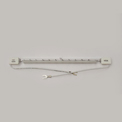
The diameter of the filament is less than the diameter of the quartz tube. So, spacers/support rings are used to keep the filament in the centre of the tube. This prevents the filament from coming in direct contact with the tube.
Pinching of the tube is also done and this prevents the filament from sagging under its weight when installed in a vertical position.
A reflective coating of Zirconium can be done on half the circumference of the tube (or as desired). This helps in focusing the heat on the object to be heated. This coating is applied in thin layers and multiple layers are applied. This achieves good adhesion and the coating does not come off.
The nominal working life of I.R. lamps is 5000 hours. Care must be taken that they are not subjected to severe vibrations and mechanical shocks.